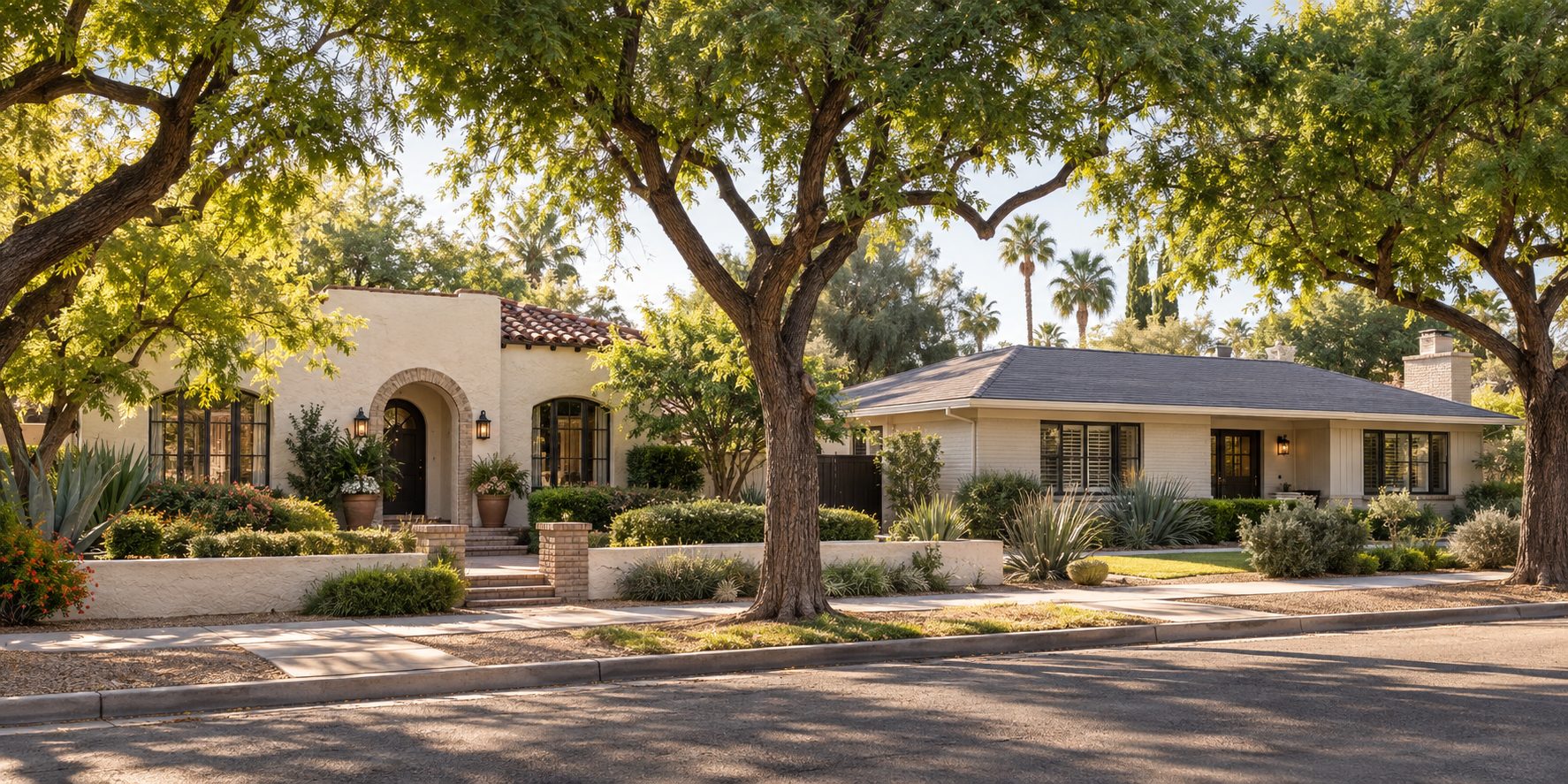
Windsor Square and Medlock Place sit across Central Avenue from one another in Uptown Phoenix, share mature trees and historic character, and are often discussed as if they were one market. They are not. Even within each district, a ZIP-code median can lead to the wrong conclusion because it blends homes that do not compete with one another.
The surrounding market includes early Period Revival homes, postwar ranches, expanded luxury residences, smaller detached houses, patio homes, townhouses, condominiums and multi-residence properties. A $500,000 attached home and a million-dollar detached historic residence do not share the same buyer pool, renovation standard or pricing logic.
Today's broader Phoenix market gives buyers more leverage, but scarce, well-executed detached homes in these districts can behave very differently from ordinary or attached inventory. The useful question is not what the ZIP code did. It is what the exact property competes with.
Where Windsor Square and Medlock Place begin and end
Windsor Square lies east of Central Avenue, generally between Oregon and Colter streets. Development began in the 1920s, the district entered the Phoenix Historic Property Register in 1996, and it is also listed in the National Register of Historic Places.
Medlock Place lies west of Central, generally between Missouri and Camelback roads. Its development spans the 1920s through the postwar period, and the City of Phoenix designated it as a residential historic district in 2003.
Public real-estate portals often use broader or inconsistent neighborhood boundaries. That is useful for browsing, but those results should not automatically become the comparable set for a pricing decision.
Why Windsor Square looks and feels different
Windsor Square was influenced by English Garden City and City Beautiful planning ideas. Sidewalks, curbs, ornamental lighting, deep setbacks, mature landscaping and flood irrigation contribute to the district's established character.
The district includes roughly 260 homes, and historic documentation identifies 178 as ranch-style residences. Windsor Square is therefore not one architectural style or one price tier. Period Revival homes, ranches, additions and later alterations all need to be evaluated differently.
Buyers often place real value on original architectural integrity, well-designed additions, lot quality, livable square footage, landscaping, permits and evidence that exterior work followed historic-review requirements. Sellers should not assume that every expensive renovation creates equal market value. Thoughtful work that respects the home tends to read differently from generic finishes or additions that compromise scale and character.
Medlock Place has an even wider property-type range
Medlock Place and its surrounding search area include historic cottages and ranches, renovated detached homes, guest-house or duplex configurations, patio homes, townhouses and nearby high-rise or condominium inventory. That range makes unfiltered portal averages especially risky.
A current public portal snapshot showed about 15 listings under the Medlock Place label, but the results mixed attached homes, patio homes and high-rise inventory with detached residences—and some were outside the strict historic-district boundary. That is not a defensible count of detached historic inventory.
Before using a sale as a comp, ask: Is it detached or attached? Is it inside the historic district? Is the lot irrigated? Does it include a guest residence or duplex use? Are additions permitted and reflected in public records? Is the renovation structural and systems-level, or mainly cosmetic? Does it attract the same buyer as the subject property? Until those questions are answered, an average can be more distracting than helpful.
What the latest public market data actually says
The latest complete public neighborhood and ZIP-code figures available on October 1 mostly cover August 2026. They are useful only with the sample-size and property-mix limitations made explicit.
Windsor Square: too few sales for a trend
Redfin's recent Windsor Square summary reported a $960,000 median sale price, 73 days on market and an average sale roughly 0.7% above list. But the period contained only three sales, with reported prices ranging from about $680,000 to $1.6 million. The displayed 43.9% annual increase is not a responsible measure of neighborhood appreciation from such a small, mix-sensitive sample.
Verified conclusion: Windsor Square does not have enough recent public sales for a dependable neighborhood-level price trend. Practical inference: the wide price range and long average exposure reinforce the need to compare architecture, lot, condition, renovation quality and scale—not merely address and ZIP code.
Medlock Place: current activity, stale summary statistics
Medlock Place's headline neighborhood summary still reflects an older period: eight sales, a $657,500 median, 31 days on market and a 97.7% sale-to-list ratio. Redfin's broader six-month competitiveness measure indicates homes have averaged about 4% below list and roughly 60 days to pending. Neither measure is strong enough to price an individual home.
Recent portal examples also show why one number fails here: a larger detached residence sold around $1.1 million after more than 100 days; an attached property near $520,000 took more than 250 days; and a smaller detached home near $570,000 also exceeded 100 days. Distinctive, thoughtfully renovated detached properties have sometimes performed better. These are examples of segmentation, not a neighborhood trend.
What the ZIP-code proxies show—and what they do not
For 85012, the latest public data reported 25 sales, down 11.8% year over year; 85 median days on market versus 95 a year earlier; a 96.6% sale-to-list ratio; price reductions on 35.2% of listings; and 16.7% of sales above list. The reported $532,270 median was up 7.6%, but the ZIP includes luxury detached homes, condos and redevelopment transactions, so the median and price per square foot are highly mix-sensitive.
For 85013, the latest public data reported 65 sales, up 32.3% year over year; 63 median days on market, 11 days faster than a year earlier; a 97.6% sale-to-list ratio; price reductions on 42.6% of listings; and 14.3% of sales above list. The reported median fell 13.4% to $484,790, but the ZIP's detached, attached and condition mix prevents that decline from being applied broadly to Medlock Place homes.
The defensible signal is buyer price sensitivity: both ZIPs had sale-to-list ratios below 100%, substantial marketing time and reductions on more than one-third of listings. The headline price direction is less reliable than the negotiation and exposure data.
Is there a defensible months-of-supply number?
Not at the neighborhood level from the public data available. A Windsor Square or Medlock Place months-of-supply calculation would swing sharply with one new listing, one contract or one closing—and would be distorted further if attached and detached properties were combined.
The broader ARMLS-based August estimate was 4.28 months of supply, up from 3.77 in July, with about 23,406 active listings and monthly closings down 13.1%. That covers a huge geography and many property types. It is useful only as broad context for a more balanced, buyer-negotiable market.
A useful micro-CMA should instead measure four things: truly competing active listings, same-type pending properties, recent same-type closings, and failed or withdrawn listings. That is the supply picture a real buyer sees.
Mortgage rates are changing the high-end payment calculation
Freddie Mac's average 30-year fixed mortgage rate reached 7.03% on September 24, up from 6.95% the prior week and 6.30% one year earlier. On an $800,000 loan, the difference between 7.03% and 6.30% is roughly $387 per month in principal and interest.
That payment shift does not eliminate demand for a well-located historic home, but it raises the cost of every pricing stretch, repair concern and unfinished renovation. Buyers are more likely to distinguish a completed, documented property from one that still requires expensive work.
Concessions are part of the market—even when the list price looks firm
Redfin reported that 67.4% of Phoenix-area sales included a seller concession during the three months ending in August 2026, up 15.3 percentage points year over year. Its definition includes items such as closing-cost help, repairs and rate buydowns, and it excludes public list-price cuts and ordinary negotiated discounts.
That is a metro statistic, not a Windsor Square or Medlock Place rate. It is still useful context because older homes can produce material inspection questions involving roofs, sewer lines, electrical systems, HVAC, irrigation, additions and permits. Sellers should plan a credit strategy before launch rather than improvise after inspection.
Historic designation: what buyers and sellers should understand
The City of Phoenix reviews exterior work in designated historic districts. Depending on the project, an owner may need a Certificate of No Effect or a Certificate of Appropriateness. Interior work that does not affect the exterior generally falls outside historic-preservation review, while routine maintenance may follow a simpler path than a material exterior change.
Buyers should verify the exact historic status, the approval history for additions and exterior changes, whether permits match the home, how windows and roof materials were handled, and whether guest-house or multi-residence uses are legal. Sellers should assemble permits, plans, invoices, historic-review records and major-system documentation before going live.
What buyers should do
- Compare like with like: detached with detached, attached with attached, and renovated with a similar level of work.
- Inspect the expensive systems carefully, including roof, sewer, electrical, HVAC, irrigation, foundation and any additions.
- Confirm historic-district status and exterior approval history before assuming a future project will be permitted.
- Use market time, prior reductions and unresolved condition issues to shape the offer and credit request.
- Ask for closing-cost or rate-buydown assistance when it improves the payment more than an equivalent price change.
- Keep inspection protections even when the house is visually impressive.
What sellers should do
- Build a micro-CMA that excludes incompatible property types and out-of-boundary sales.
- Price the quality of the renovation—not merely its cost—and document the systems work behind the finishes.
- Gather permits, historic approvals, plans, invoices and major-system records before buyers ask.
- Resolve visible uncertainty where practical; buyers often translate unanswered questions into a larger credit request.
- Pre-plan a concession budget and compare every offer by net proceeds.
- Review response within the first two weeks using showings, saves, buyer feedback and new competing inventory.
The BLONDIE & BARKSTROM approach
Windsor Square and Medlock Place cannot be priced responsibly from an automated ZIP-code average. BLONDIE & BARKSTROM micro-CMAs separate detached homes from condos and attached units, account for renovation quality, historic status, lot, guest-house or multi-residence features, and show the active and pending homes that define the real competition.
If you are considering a sale, reduction or offer, ask Megan and Jake for a candid property-specific micro-CMA before making the decision.
Frequently asked questions
Are Windsor Square and Medlock Place the same neighborhood?
No. Windsor Square is east of Central Avenue and Medlock Place is west of Central. They share an Uptown location and historic character, but their development patterns and property mix are not identical.
Is Windsor Square a seller's market?
The recent public sample is too small to label the neighborhood responsibly. Only three sales drove the latest reported median, so property-specific competition matters more than the headline statistic.
Can a home in these historic districts be remodeled?
Yes, but material exterior changes may require City of Phoenix historic-preservation review. Buyers and owners should confirm the approval path before finalizing plans.
Why can ZIP-code trends differ so much from the neighborhood?
ZIP codes combine incompatible property types, price tiers and conditions. Condos, attached homes, luxury estates and redevelopment sales can move a ZIP median without reflecting a comparable detached historic home's value.
What should buyers inspect most carefully?
In addition to a full general inspection, pay close attention to the roof, sewer, electrical system, HVAC, irrigation, foundation, additions, permits and historic-review records.
Sources and methodology
Market data was checked October 1, 2026. Neighborhood samples are small and public portal boundaries may not match the official historic districts. ZIP-code and metro figures provide context only; they are not substitutes for a micro-CMA based on compatible properties.
Sources & further reading
We fact-checked this article using the following sources:
- City of Phoenix: Residential historic districts
- City of Phoenix: Historic preservation frequently asked questions
- City of Phoenix: Historic preservation approvals and guidelines
- City of Phoenix: Windsor Square Historic District documentation
- National Park Service: Windsor Square Historic District
- Redfin: Windsor Square housing market
- Redfin: Medlock Place housing market
- Redfin: 85012 housing market
- Redfin: 85013 housing market
- Freddie Mac: Primary Mortgage Market Survey archive
- Redfin: Seller concessions in August 2026
- ARMLS-based Phoenix housing market update, August 2026
Market data was checked October 1, 2026. Windsor Square and Medlock Place have small, uneven neighborhood samples, so broad ZIP-code and metro figures are used only as context. They are not substitutes for a property-specific micro-CMA using truly comparable homes.